Engineering AI agents you can trust with real work.
Agentic Engineering is the discipline of building AI systems that pursue goals on their own: planning, using tools, collaborating with other agents and checking in with people. It is where AI moves from answering to doing. It is also where UFUIMI leads.
A loop, not a single prompt.
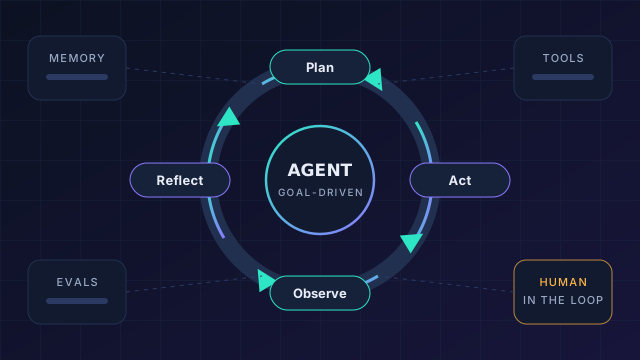
An agent works in a continuous cycle: it plans the steps toward a goal, acts through tools and APIs, observes the results and reflects to correct course, drawing on memory and escalating to humans when it should.
Making that loop reliable takes more than a clever prompt. It takes architecture, evaluation, guardrails and operational rigour. That is the engineering in Agentic Engineering.
Full-lifecycle Agentic Engineering.
Agent architecture
Single-agent and multi-agent designs, with orchestrators, specialist roles and clear handoffs matched to your workflow.
Tools & integrations
Secure tool use across your APIs, databases and SaaS apps, including Model Context Protocol servers built to spec.
Evaluation & testing
Task-level evals, regression suites and simulation harnesses that measure whether agents actually complete the job.
Guardrails & governance
Permissions, approval gates, policy checks and full audit trails, so autonomy never outruns accountability.
Observability & operations
Tracing, cost and latency monitoring, and continuous improvement loops for agents running in production.
Agentic software development
We help engineering teams adopt coding agents and agent-driven delivery methods to ship faster with higher quality.
How we engineer dependable agents.
Start with the outcome
Every agent is defined by the business result it owns, with measurable success criteria agreed before a line of code is written.
Autonomy is earned
Agents begin with tight supervision and gain independence as evaluations prove they are ready for it.
Proof over promises
We show working results against real tasks, not demos. If it isn't measured, it isn't done.
People stay in charge
Agents amplify your teams. Clear escalation paths keep humans in control of the decisions that matter.
A new kind of team.
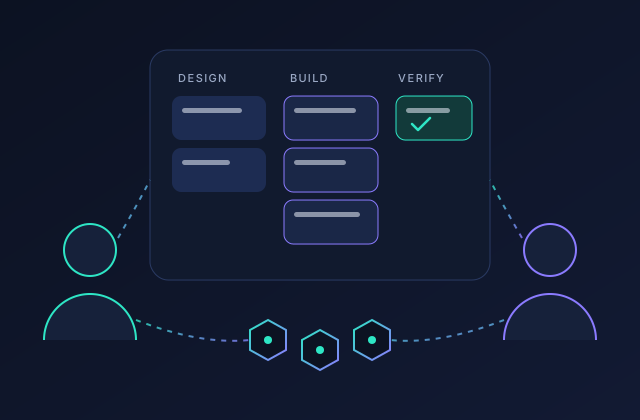
The organisations that win with AI won't just use tools. They'll run blended teams where people set direction and agents carry out the work at machine speed.
- Agents that own repeatable, multi-step tasks end to end
- People focused on judgement, relationships and strategy
- Shared visibility into what every agent is doing and why
Agentic Engineering, explained.
How is an AI agent different from a chatbot?
A chatbot responds to a message. An agent is given a goal and works toward it: deciding on steps, using tools and systems, checking results and continuing until the task is complete or it needs a human decision.
Is it safe to let AI take actions in our systems?
Yes, when it is engineered properly. We scope permissions tightly, add approval gates for sensitive actions, log every step and test agents against realistic scenarios before they go live.
Which AI models do you use?
We are model-agnostic. We select from leading frontier and open-weight models based on the task, cost, latency and your data requirements, and design so models can be swapped as better options emerge.
How quickly can we see results?
Most engagements reach a working pilot on a real workflow within weeks, followed by measured expansion into production.
Work with leading experts in Agentic Engineering.
Bring us the workflow. We'll bring the agents, the engineering and the proof.